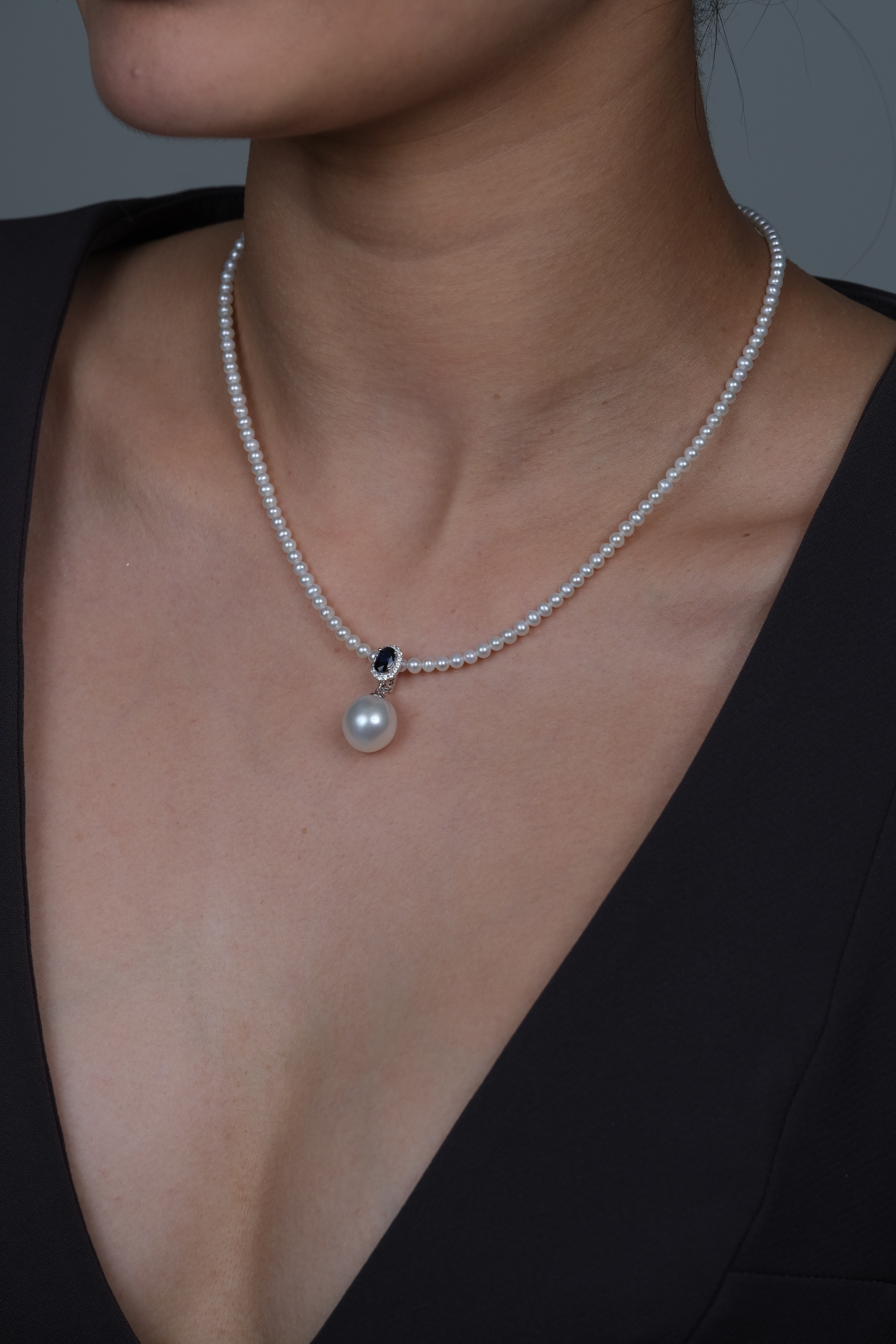
Freshwater Pearls
Updated 22nd November 2026
Freshwater pearls are grown in freshwater mussels rather than saltwater oysters. Almost all of them come from China, where farmers raise the triangle shell mussel, Hyriopsis cumingii, and its hybrids in lakes and ponds, mostly in the provinces of Zhejiang, Jiangxi and Hubei.
Most freshwater pearls are grown from a small piece of mantle tissue rather than a shell bead. The mussel builds the whole pearl out of nacre, so a freshwater pearl is solid nacre from the surface to the centre. A single mussel can grow many pearls at once, which is why freshwater pearls are the most widely available pearls in the world, and the most affordable for their size.
Sizes
Freshwater pearls range from tiny seed pearls of 2mm to large pearls of 12mm and more. Most are between 5mm and 9mm. Larger freshwater pearls of 10mm to 13mm, and bead-nucleated pearls that can reach 15mm, are less common and are often baroque or oval rather than round.
Colours and overtones
Freshwater pearls grow naturally in white and cream, and in soft shades of pink, peach and lavender. Their overtones are gentle, often rose or silver. Stronger colours such as black, blue or deep purple are produced by dyeing, and we always state when a pearl is dyed.
Shapes
Freshwater pearls come in every shape, from Round and Near Round to Button, Drop, Oval and Baroque. Round freshwater pearls were once rare, and farming has improved to the point where well-rounded strands are now widely available. Baroque and keshi freshwater pearls are favourites for modern designs.
What makes a good freshwater pearl
Freshwater pearls tend to have a softer, satin lustre than Akoya pearls, so lustre is still the first thing to compare. The best freshwater pearls have bright, clear reflections that rival saltwater pearls. Next, look at the surface for spots and ripples, and at the shape. In a strand, look for even matching of size and colour along its length.
Value
Freshwater pearls give you the most pearl for your money, in the widest range of colours and shapes. A large, round, high-lustre freshwater pearl is still a prize, and the finest freshwater strands are priced alongside good Akoya pearls.
Caring for freshwater pearls
Because they are solid nacre, freshwater pearls are hard-wearing and well suited to everyday jewellery. Treat them like any pearl: keep them away from chemicals, wipe them after wearing and store them apart from harder jewellery. Our Care Guide covers the rest.
Why we sell them
Freshwater pearls are the most versatile and also the most budget friendly. They come in a variety of colours, sizes, and overtones and can be mixed and matched for your style.
FAQ
Are freshwater pearls real pearls?
Yes. They are cultured pearls grown by freshwater mussels, and most are solid nacre all the way through.
Are freshwater pearls good quality?
They range from simple pearls to some of the finest on the market. Compare lustre, surface and shape, which our descriptions and grading list for every piece.
Are coloured freshwater pearls natural?
White, cream, pink, peach and lavender occur naturally. Black, blue and other strong colours are dyed, and every dyed pearl we sell says so.