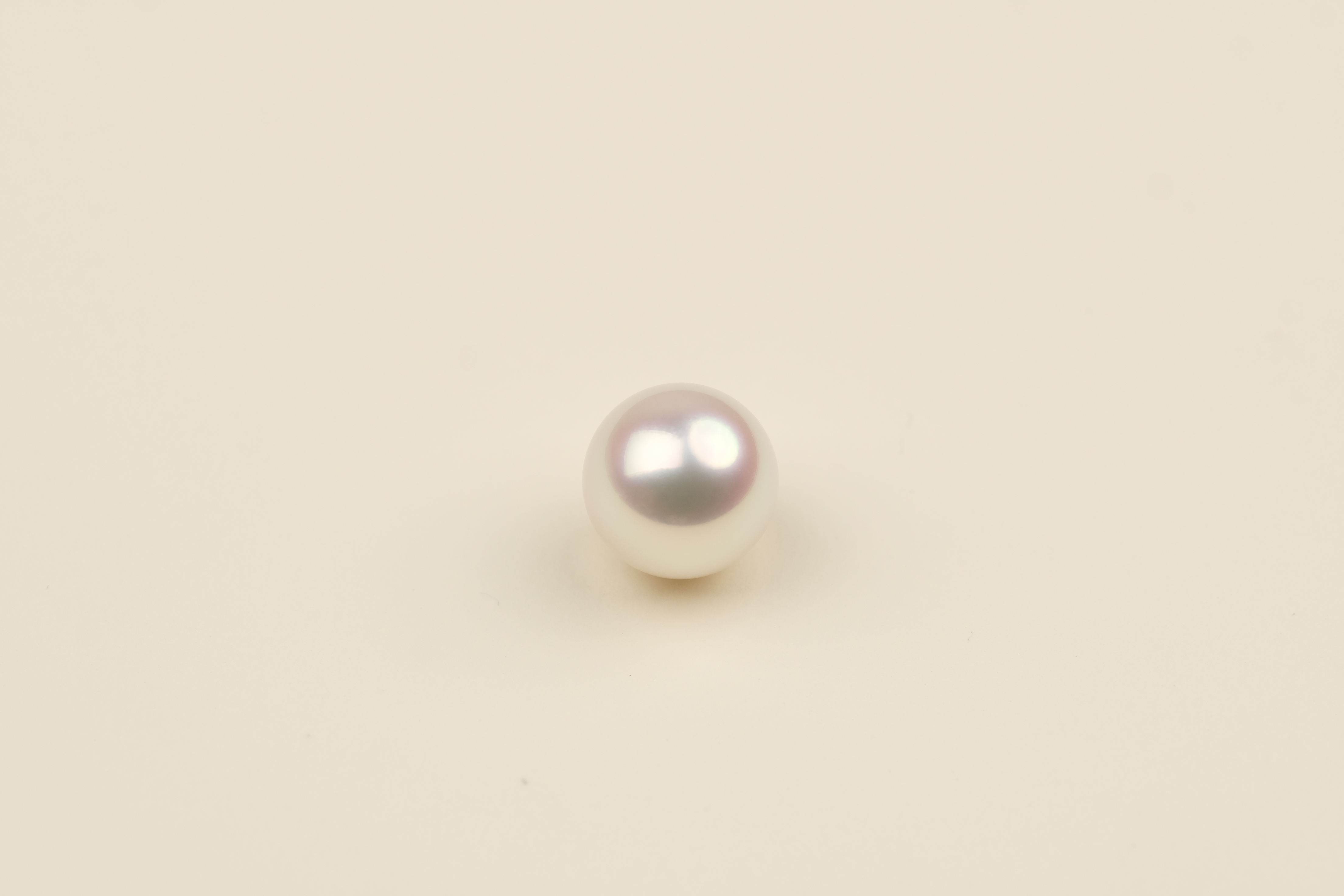
Akoya Pearls
Updated 22nd November 2026
Akoya pearls are the classic white pearl of a strand or a pair of studs. They are grown in the Akoya pearl oyster, Pinctada fucata, a small saltwater oyster farmed mainly in the sheltered bays of southern Japan, with smaller harvests from China and Vietnam. Japan's farms in Ehime, Mie and Nagasaki have cultured Akoya pearls for more than a century, and they are still the reference for the type. We source our Akoya exclusively from Japan.
Each Akoya pearl is grown around a round shell bead. The oyster coats the bead with nacre for one to two years before harvest. Because the oyster is small, so are its pearls, and their nacre is thinner than that of the larger South Sea types. What Akoya pearls lack in size they make up for in lustre: a good Akoya pearl reflects light as sharply as a mirror.
Sizes
Akoya pearls range from about 2mm to 10mm. Most are between 6mm and 8mm, which is the size of a classic strand or stud. Pearls of 8mm to 9mm are less common, and pearls over 9mm are rare and priced accordingly. Small sizes from 2mm to 5mm are used for fine chains and accents.
Colours and overtones
Most Akoya pearls are white or cream, often with a rose overtone that gives the skin a soft pink glow. Silver and blue overtones also occur. Naturally blue-grey Akoya pearls, sometimes sold as madama, are less common. Akoya pearls in strong colours such as black or gold are dyed, and we always say so in the description.
Shapes
Because they grow around a round bead, most Akoya pearls are Round or Near Round, which is why they are the usual choice for perfectly matched strands. Baroque and keshi Akoya pearls are also harvested, and they have a charm of their own.
What makes a good Akoya pearl
Look at lustre first. A high-quality Akoya pearl shows crisp, bright reflections, and you should be able to see the outline of a light or a window in its surface. Then look at the surface, which should be as clean as possible, and at the nacre, which should look smooth rather than rippled. In a strand, check that the pearls are evenly matched in size, colour and lustre from end to end.
The finest Akoya pearls can carry a Hanadama (or above) certificate, which is only issued for Akoya pearls tested by the Japan Pearl Institute or the Pearl Science Laboratory and found to have thick nacre and top lustre. See Grading Guidelines.
Value
Size for size, Akoya pearls cost more than freshwater pearls and less than South Sea pearls. Their value comes from their round shape and high lustre, and it rises steeply with size, because large Akoya pearls are so uncommon.
Caring for Akoya pearls
Akoya nacre is thinner than that of larger types, so it pays to keep Akoya pearls away from perfume, hairspray and cleaning products, and to wipe them with a soft cloth after wearing. A strand worn often should be restrung every year or two. Our Care Guide covers the rest.
Why we sell them
Akoya pearls offer a perfect middle ground between freshwater and South Sea pearls in terms of price and value. If you are happier with a smaller size, but want something fancier than a freshwater pearl, then an Akoya pearl might be just right for you. Visually, a high quality Akoya pearl will be shinier than a South Sea pearl, which has a softer glow.
FAQ
Are Akoya pearls real pearls?
Yes. Akoya pearls are cultured pearls grown by the Akoya oyster. The oyster builds the nacre around a bead placed by the farmer, and the nacre is genuine pearl.
What size Akoya pearl should I choose?
For studs and everyday strands, 6mm to 8mm suits most people. Choose 8mm and above for a fuller look, and below 6mm for a delicate one. See the Size Guide.
Why do Akoya pearls cost more than freshwater pearls of the same size?
An Akoya oyster grows only one or two pearls at a time and few of them reach the top grades, while a freshwater mussel grows many pearls at once. The sharper lustre of a good Akoya pearl is the other reason.